Large Suburban Garden Installation in Saco
A layered, four-season landscape designed for privacy, structure, and year-round interest
Project Details
This large garden installation in Saco, Maine transformed several open and disconnected planting areas into a series of gardens that feel connected to both the home and one another.
The goal was not to create one continuous style across the entire property. Instead, each garden was designed in response to its location, the architecture of the house, and the way the homeowners experience the property.
Some areas called for restraint and structure. Others needed softness, seasonal color, or greater privacy. Together, the gardens create a landscape that feels established and welcoming while still having room to mature and evolve.
A Japanese-Inspired Foundation Garden
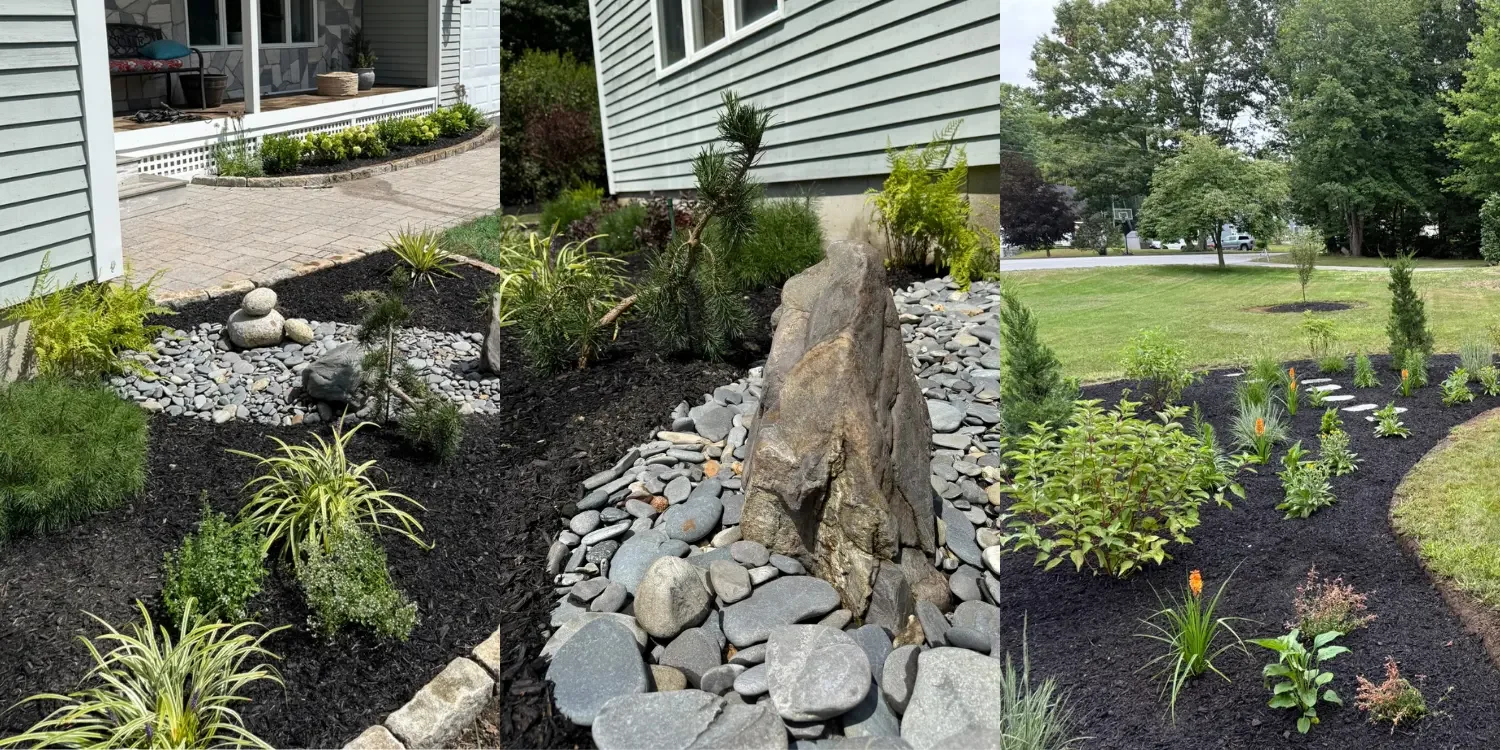
The planting directly along the front of the house was designed with a quieter, Japanese-inspired character.
Mugo pines provide low evergreen structure, while compact weigela helps soften and visually cover the exposed foundation. White-flowering calamint, yucca, low groundcovers, and contrasting foliage bring texture and movement without making the planting feel overly busy.
The plant palette for this area included weigela, calamint, woolly thyme, golden Irish moss, creeping juniper, mugo pine, and the distinctive Pinus banksiana ‘Uncle Fogy’.
A flowering cherry tree anchors one side of the foundation planting. On the opposite end, lower plantings transition into a stone installation featuring creeping thyme, juniper, and the unusual ‘Uncle Fogy’ pine.
The stonework was intentionally incorporated as more than a decorative feature. It also functions as a practical drip zone alongside the house, allowing a necessary part of the property to become part of the overall garden composition.
The result is a foundation garden built around texture, form, and restraint rather than relying solely on flowers.
A Classic Planting Along the Porch
In front of the porch, the planting changes character.
Here, we used a more traditional foundation treatment, alternating compact hydrangeas with evergreen inkberry. ‘Fire Light Tidbit’ hydrangeas provide a long flowering season while inkberry gives the planting dependable evergreen structure.
The repeating pattern creates a calm transition across the front of the porch while keeping the planting appropriately scaled to the architecture. In winter, the inkberry continues to hold the composition together even after the hydrangeas have gone dormant.
Privacy Without Creating a Wall
The largest front garden presented a different design challenge.
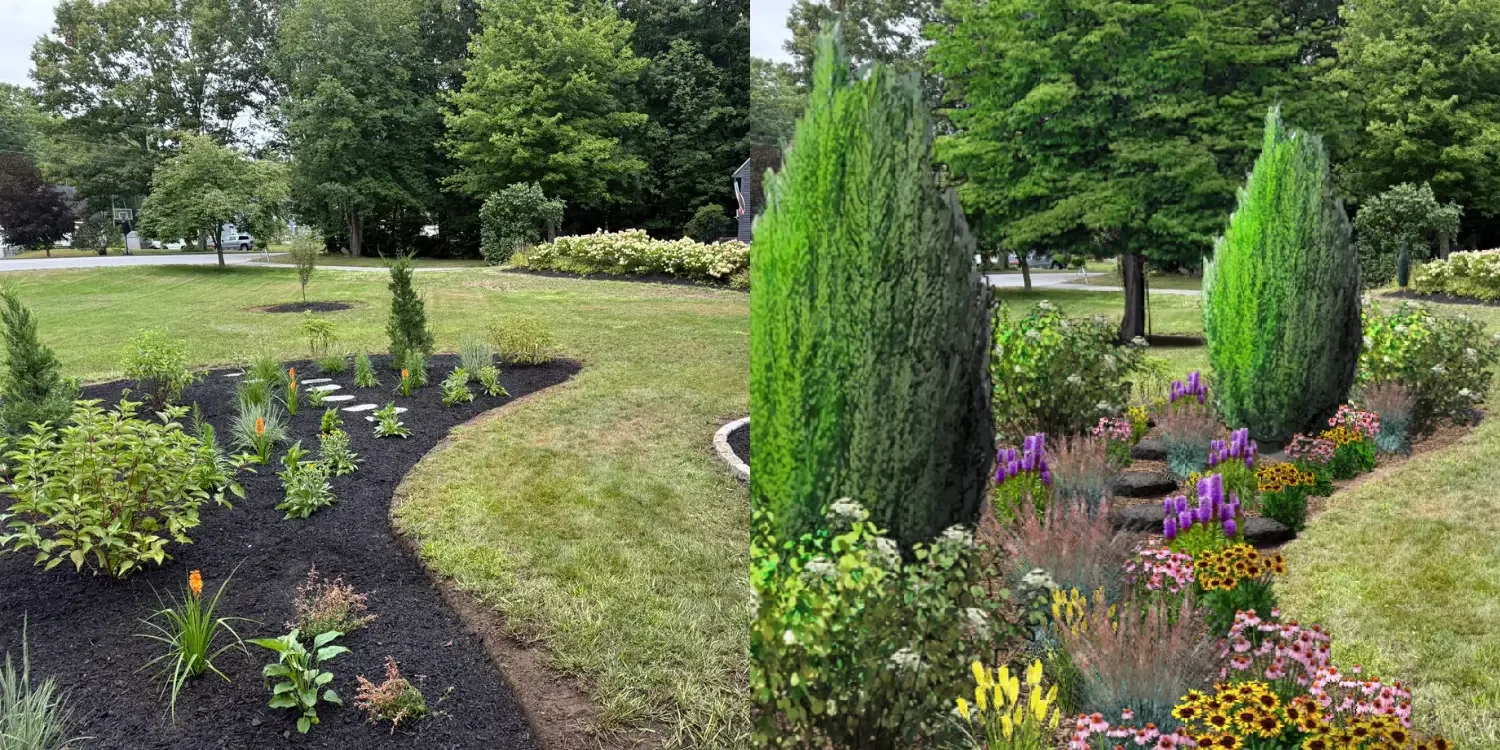
The homeowners wanted greater privacy as the garden matured, but we did not want to accomplish that by creating a dense hedge or visual wall. Instead, the garden was designed as a layered composition.
Columnar junipers hold each side of the planting and provide strong vertical evergreen structure. Different species of red-twig dogwoods create intermediate layers of height, gradually stepping down toward a lower central valley.
That center becomes the most colorful and dynamic part of the garden, filled with flowering perennials and ornamental grasses. Rather than blocking the property from view, the taller planting frames it.
As the plants mature, the garden will provide increasing privacy while retaining an open, inviting quality. Together, these plants provide different heights, flowering periods, textures, foliage colors, and growth habits rather than relying on a single type of screening plant.
A ‘White Galaxy’ Korean Dogwood as a Garden of Its Own
Elsewhere on the property, a full-sized ‘White Galaxy’ Korean dogwood was planted in a separate bed.
Rather than incorporating the tree into the larger privacy planting, we gave it its own space where its natural form can become an important landscape feature as it matures.
The Korean dogwood adds another vertical layer to the property while providing a distinct flowering focal point separate from the foundation and front gardens. Over time, this planting should become increasingly important to the overall landscape as the tree gains height, canopy, and presence and offers shade.
Designed for More Than One Season
An important goal throughout the project was to avoid creating a garden that reaches its peak for only a few weeks each summer.
Instead, the plant palette was selected so that different elements take their turn throughout the year.
Spring and summer flowering plants transition into later-season perennials such as black-eyed Susan, hummingbird mint, blazing star, coneflower, allium, hydrangea, and ornamental grasses.
Evergreens such as mugo pine, inkberry, juniper, and ‘Uncle Fogy’ pine continue providing structure when the perennial garden goes dormant.
Dogwoods contribute branching structure and stem interest through the colder months, while grasses and perennial seed heads can continue adding movement and texture well beyond their flowering period.
The intention is for the garden to change rather than disappear with the seasons.
A Garden Designed to Mature
The photographs taken immediately after installation show the beginning of the garden—not the finished story.
The plants were intentionally given space to establish and grow into their mature forms.
As the shrubs fill out, perennials knit together, ornamental grasses gain size, and the trees establish themselves, the relationships between the different planting layers will become increasingly apparent.
This is a garden designed not simply for installation day, but for the years ahead.